
Why Businesses Are Moving Towards Restricted Key Systems
September 21, 2026For offices, schools, landlords and managed properties, physical keys are still a practical way to control access. The problem is that standard keys can become difficult to manage once multiple people, doors and locations are involved.
That is why more organisations are looking at restricted key systems for businesses. These systems are designed to give property managers greater control over who can obtain additional keys, while still retaining the simplicity of mechanical locks. They can also form part of a wider access strategy alongside master key systems or electronic access control.
The Main Reason Businesses Choose Restricted Keys
The biggest advantage is key control.
With an ordinary key, a business may have limited visibility over how many copies exist or whether additional copies have been made elsewhere. A restricted key system places tighter controls around duplication, typically requiring appropriate authorisation before additional keys can be supplied.
For organisations managing staff, contractors, tenants or multiple departments, this makes it easier to maintain a clearer picture of who should have access and how replacement keys are issued.
The Master Locksmiths Association‘s guidance on security and restricted keys also sets out controls around the duplication of restricted, registered and master keys, including the need for appropriate authorisation.
Where Standard Key Management Can Become a Problem
A small office with a few employees and one entrance may be relatively simple to manage. The challenge increases when a building has multiple doors, departments and authorised users.
Common problems can include:
- Employees leaving without returning issued keys
- Contractors requiring access for a limited period
- Managers carrying several unrelated keys
- Copies being made without the appropriate person knowing
- Different employees requiring different levels of access
- Multiple properties being managed by the same organisation
- Replacement keys being requested without a consistent authorisation process
These situations do not automatically mean a business needs electronic access control. A carefully planned mechanical key system can still provide an effective way to organise access.
What Makes a Restricted Key System Different?
A restricted key system uses a controlled key profile rather than relying on a conventional key that can readily be duplicated through ordinary key-cutting channels.
The exact controls vary between systems. Additional keys may require appropriate authorisation, a security card or another verification process before they can be supplied.
Some restricted systems also use patented key technology to provide additional protection against unauthorised duplication.
It is important to be precise about what this means. A restricted key should not simply be described as impossible to copy. Its key advantage is that legitimate duplication takes place through a controlled process, with the specific protections depending on the chosen system.
Morgans Locksmiths works with specialist key systems as part of its professional key cutting services, including registered and restricted keys.
Restricted Keys & Master Key Systems Solve Different Problems
Restricted key systems and master key systems are closely related, but the terms do not mean the same thing.
A restricted key system controls how additional keys can legitimately be produced.
A master key system determines which locks an individual key can operate.
The two approaches can work together.
For example, an employee might receive a key that operates the main entrance and their department, while a facilities manager holds a master key capable of opening several authorised areas. Using restricted keys within this hierarchy can add control over how additional keys are supplied.
A professionally designed master key system can therefore help organisations manage different levels of access without requiring every authorised person to carry numerous individual keys.
Which Organisations Can Benefit From Restricted Keys?
Restricted systems can be useful whenever several people require physical access but not necessarily to every part of a property.
Offices & Commercial Premises
Offices can contain staff entrances, individual offices, stockrooms, plant rooms and management areas.
A structured key system allows access to be planned around roles and responsibilities rather than giving every employee the same keys.
Schools & Education Settings
Schools may need to manage access across classrooms, offices, storage areas and other restricted spaces, with keys potentially required by teachers, caretakers, management teams and approved contractors.
A controlled key hierarchy can help ensure different users receive access appropriate to their responsibilities.
Landlords & Property Managers
Managing several properties can quickly result in a substantial collection of keys.
Restricted and master key systems can help landlords, managing agents and maintenance teams organise access while maintaining separate permissions for tenants and individual properties.
Multi-Site Organisations
Businesses responsible for several premises may have an additional challenge: creating an access structure that remains manageable as buildings, employees or responsibilities change.
Planning the hierarchy before choosing individual locks can make the system easier to administer over the longer term.
Better Key Control Is About More Than Lost Keys
A missing key is an obvious security concern, but uncertainty about how many keys exist can be just as important.
If conventional keys have been duplicated repeatedly over several years, an organisation may no longer have a reliable picture of every copy in circulation.
Restricted systems can support stronger internal key-management procedures, such as:
- Recording who receives each key
- Restricting who is authorised to request duplicates
- Recovering issued keys when employees leave
- Reviewing access permissions when roles change
- Documenting which areas individual keys can access
- Limiting unnecessary distribution of higher-level keys
The locking system is only one part of good access management. Businesses still need clear procedures for issuing, recording and recovering keys.
When Is Electronic Access Control More Appropriate?
Restricted mechanical keys are not automatically the right solution for every door or organisation.
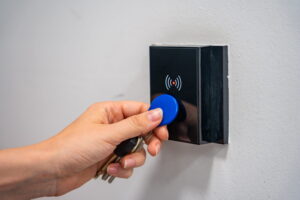
Electronic access control systems may be more suitable where a business needs to change permissions regularly, deactivate lost credentials quickly or manage different users without issuing conventional keys.
The two approaches can also complement one another.
For example, electronic access could be used at a main staff entrance while restricted mechanical keys protect offices, cupboards, storage rooms or other internal areas.
The right approach depends on the building, number of users, security requirements and how frequently access permissions need to change.
What Should You Consider Before Changing Your Key System?
Before replacing cylinders or ordering new keys, it helps to understand how people actually move through the property.
Consider:
Planning these requirements first can help avoid replacing an unmanageable collection of conventional keys with an equally complicated new system.
For larger or more complex premises, a commercial locksmith can assess the existing arrangement and help determine an appropriate access structure.
Frequently Asked Questions
Can Restricted Keys Be Copied?
Yes, authorised additional keys can generally be produced according to the controls of the particular restricted system. The purpose is to make legitimate duplication controlled rather than to suggest that copying is physically impossible. The authorisation process varies between manufacturers and systems.
Are Restricted Keys Only Suitable for Large Businesses?
No. The usefulness of a restricted key system depends more on access requirements than organisation size. Smaller offices, landlords and businesses with sensitive rooms or several authorised keyholders may also benefit from tighter control over duplication.
Can Restricted Keys Work With a Master Key System?
Yes. Restricted key control and master keying can be combined. Different users can then have keys providing different levels of access while additional key production remains subject to the controls of the chosen system.
What Happens When an Employee Leaves?
Issued keys should be recovered and the organisation’s key records updated. Restricted systems can provide better control over legitimate duplication, but they do not replace good internal procedures. If a key is missing, the appropriate response will depend on the areas it accesses and the design of the system.
Are Restricted Keys Better Than Access Control?
Not necessarily. They meet different requirements. Restricted keys provide controlled mechanical access, while electronic access control can offer greater flexibility when credentials or permissions need to change frequently. Some commercial properties benefit from using both.
Build Your Key System Around How Your Property Works
A restricted key system is ultimately about more than choosing a different type of key. The real benefit is creating a more controlled approach to duplication and deciding who should have access to different parts of a property.
For offices, schools, landlords and other managed premises, that can make physical key management clearer and easier to administer.
Morgans Locksmiths supports businesses with restricted keys, master key systems and wider commercial security solutions. If you are reviewing access across a property in Leicester or the surrounding area, contact Morgans Locksmiths to discuss your requirements.